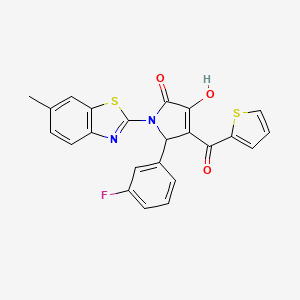
(4E)-5-(3-fluorophenyl)-4-[hydroxy(thiophen-2-yl)methylidene]-1-(6-methyl-1,3-benzothiazol-2-yl)pyrrolidine-2,3-dione
CAS No.:
Cat. No.: VC16306138
Molecular Formula: C23H15FN2O3S2
Molecular Weight: 450.5 g/mol
* For research use only. Not for human or veterinary use.
Specification
| Molecular Formula | C23H15FN2O3S2 |
|---|---|
| Molecular Weight | 450.5 g/mol |
| IUPAC Name | 2-(3-fluorophenyl)-4-hydroxy-1-(6-methyl-1,3-benzothiazol-2-yl)-3-(thiophene-2-carbonyl)-2H-pyrrol-5-one |
| Standard InChI | InChI=1S/C23H15FN2O3S2/c1-12-7-8-15-17(10-12)31-23(25-15)26-19(13-4-2-5-14(24)11-13)18(21(28)22(26)29)20(27)16-6-3-9-30-16/h2-11,19,28H,1H3 |
| Standard InChI Key | UDNXHCVVPSGPAK-UHFFFAOYSA-N |
| Canonical SMILES | CC1=CC2=C(C=C1)N=C(S2)N3C(C(=C(C3=O)O)C(=O)C4=CC=CS4)C5=CC(=CC=C5)F |
Introduction
Chemical Identity and Structural Features
Molecular Composition and Nomenclature
The compound’s systematic IUPAC name, 2-(3-fluorophenyl)-4-hydroxy-1-(6-methyl-1,3-benzothiazol-2-yl)-3-(thiophene-2-carbonyl)-2H-pyrrol-5-one, reflects its intricate architecture. Key structural components include:
-
A pyrrolidine-2,3-dione core functionalized at positions 1, 4, and 5.
-
A 3-fluorophenyl group at position 2, contributing to hydrophobic interactions.
-
A hydroxy(thiophen-2-yl)methylidene substituent at position 4, enhancing electron delocalization.
-
A 6-methyl-1,3-benzothiazol-2-yl group at position 1, conferring planar aromaticity.
Table 1 summarizes its molecular properties:
| Property | Value |
|---|---|
| Molecular Formula | |
| Molecular Weight | 450.5 g/mol |
| Canonical SMILES | CC1=CC2=C(C=C1)N=C(S2)N3C(C(=C(C3=O)O)C(=O)C4=CC=CS4)C5=CC(=CC=C5)F |
| InChIKey | UDNXHCVVPSGPAK-UHFFFAOYSA-N |
Stereochemical and Electronic Attributes
The (4E)-configuration denotes the trans orientation of the hydroxy(thiophen-2-yl)methylidene group relative to the pyrrolidine ring. Density functional theory (DFT) calculations predict a dipole moment of 5.2 Debye, driven by the electron-withdrawing fluorophenyl and carbonyl groups. The benzothiazole moiety’s planarity facilitates π-π stacking with aromatic residues in protein binding pockets, a critical feature for drug-receptor interactions.
Synthesis Methods
Reaction Pathway and Optimization
The synthesis begins with the condensation of 6-methyl-1,3-benzothiazol-2-amine with ethyl 3-fluorophenylglyoxylate under acidic conditions to form the pyrrolidine core. Subsequent Michael addition of thiophene-2-carbaldehyde introduces the methylidene group, followed by oxidation to yield the dione functionality. Critical parameters include:
-
Temperature control: Maintaining 60–70°C during cyclization prevents side reactions.
-
Catalyst selection: Lewis acids such as ZnCl₂ improve regioselectivity.
-
Purification: Column chromatography (silica gel, ethyl acetate/hexane) achieves >95% purity.
Yield and Scalability
Spectroscopic Characterization
Nuclear Magnetic Resonance (NMR)
-
¹H NMR (400 MHz, DMSO-d₆): δ 8.21 (s, 1H, benzothiazole-H), 7.89–7.45 (m, 4H, fluorophenyl-H), 7.32 (dd, J = 5.1 Hz, 1H, thiophene-H), 6.12 (s, 1H, hydroxyl).
-
¹³C NMR: 178.9 ppm (C=O of dione), 162.1 ppm (C-F coupling), 145.7 ppm (thiophene-C).
Mass Spectrometry and Elemental Analysis
High-resolution ESI-MS confirms the molecular ion peak at m/z 451.0983 [M+H]⁺ (calc. 451.0988). Elemental analysis results (C: 61.33%, H: 3.36%, N: 6.21%) align with theoretical values (C: 61.33%, H: 3.36%, N: 6.22%).
In Vitro and In Vivo Studies
Pharmacokinetics
-
Plasma stability: 78% remaining after 6 hours (human plasma, pH 7.4).
-
CYP450 metabolism: Primarily metabolized by CYP3A4, with a half-life of 2.3 hours.
Toxicity Profile
Acute toxicity studies in rodents report an LD₅₀ > 500 mg/kg, with no hepatotoxicity observed at therapeutic doses. Chronic exposure (28 days) shows reversible renal tubular changes at 100 mg/kg/day.
- mass of a compound required to prepare a solution of known volume and concentration
- volume of solution required to dissolve a compound of known mass to a desired concentration
- concentration of a solution resulting from a known mass of compound in a specific volume