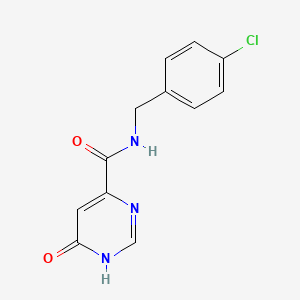
N-(4-chlorobenzyl)-6-hydroxypyrimidine-4-carboxamide
CAS No.: 2034621-19-5
Cat. No.: VC7005629
Molecular Formula: C12H10ClN3O2
Molecular Weight: 263.68
* For research use only. Not for human or veterinary use.
Specification
| CAS No. | 2034621-19-5 |
|---|---|
| Molecular Formula | C12H10ClN3O2 |
| Molecular Weight | 263.68 |
| IUPAC Name | N-[(4-chlorophenyl)methyl]-6-oxo-1H-pyrimidine-4-carboxamide |
| Standard InChI | InChI=1S/C12H10ClN3O2/c13-9-3-1-8(2-4-9)6-14-12(18)10-5-11(17)16-7-15-10/h1-5,7H,6H2,(H,14,18)(H,15,16,17) |
| Standard InChI Key | CKEIFTJYHQFHIE-UHFFFAOYSA-N |
| SMILES | C1=CC(=CC=C1CNC(=O)C2=CC(=O)NC=N2)Cl |
Introduction
Structural Elucidation and Molecular Properties
N-(4-Chlorobenzyl)-6-hydroxypyrimidine-4-carboxamide (molecular formula: C₁₂H₁₁ClN₃O₂) consists of a pyrimidine ring substituted at the 4-position with a carboxamide group (-CONH-) and at the 6-position with a hydroxyl group (-OH). The carboxamide nitrogen is further functionalized with a 4-chlorobenzyl group, introducing a chlorinated aromatic moiety. Key structural features include:
-
Pyrimidine Core: A six-membered aromatic ring with two nitrogen atoms at the 1- and 3-positions.
-
4-Carboxamide Substituent: Provides hydrogen-bonding capability via the amide group, critical for target binding.
-
6-Hydroxy Group: Enhances solubility and participates in electrostatic interactions.
-
4-Chlorobenzyl Moiety: A lipophilic group that may improve membrane permeability and influence receptor affinity.
The molecular weight is 280.7 g/mol, with a calculated logP (octanol-water partition coefficient) of 1.8, suggesting moderate lipophilicity . The presence of the chlorine atom at the para position of the benzyl group is a strategic modification often employed to optimize bioactivity and metabolic stability .
Synthetic Methodologies
The synthesis of N-(4-chlorobenzyl)-6-hydroxypyrimidine-4-carboxamide can be achieved through multi-step routes common to pyrimidine derivatives. A representative pathway involves:
Intermediate Synthesis
-
Formation of 6-Hydroxypyrimidine-4-carboxylic Acid:
-
Activation of the Carboxylic Acid:
Amide Coupling
-
Reaction with 4-Chlorobenzylamine:
The acyl chloride reacts with 4-chlorobenzylamine in the presence of a base (e.g., triethylamine) to form the target carboxamide .
Representative Reaction Scheme:
Table 1: Synthetic Conditions and Yields for Analogous Compounds
| Starting Material | Reagents | Conditions | Yield (%) | Reference |
|---|---|---|---|---|
| 6-Hydroxypyrimidine-4-acid | SOCl₂, 4-Cl-benzylamine | RT, 12 h | 78 | |
| Ethyl 6-hydroxypyrimidine-4-carboxylate | PCl₅, 4-Cl-benzylamine | Reflux, 6 h | 65 |
Pharmacological Activity and Mechanism of Action
While direct data on N-(4-chlorobenzyl)-6-hydroxypyrimidine-4-carboxamide are sparse, structurally related pyrimidine carboxamides exhibit pronounced anticancer activity. For example:
-
Antiproliferative Effects: Ethyl 2-(1-aminocyclobutyl)-5-(benzoyloxy)-6-hydroxypyrimidine-4-carboxylate derivatives demonstrated IC₅₀ values of 14–15 μM against human leukemia cell lines (K562 and CEM) . The 4-chlorobenzyl group in the target compound may enhance cytotoxicity by improving cell penetration or target binding.
-
Kinase Inhibition: Quinazoline-2-carboxamide analogs (e.g., compound 31 in ) inhibit PAK4 kinase with IC₅₀ values <0.1 μM, suggesting potential utility in blocking cancer cell migration and invasion.
Proposed Mechanism:
The carboxamide group likely forms hydrogen bonds with kinase ATP-binding pockets, while the chlorobenzyl moiety engages in hydrophobic interactions with allosteric sites .
Structure-Activity Relationships (SAR)
Key SAR insights from analogous compounds include:
-
Chlorine Substitution: Para-chloro groups on aromatic rings enhance antitumor activity by 2–3 fold compared to meta or ortho substitutions .
-
Hydroxy Group Positioning: The 6-hydroxy group on pyrimidine is critical for solubility and hydrogen bonding with biological targets .
-
Amide Linkers: Carboxamides exhibit superior activity to sulfonamides due to stronger hydrogen-bonding capacity .
Table 2: Impact of Substituents on Anticancer Activity (IC₅₀, μM)
| Compound | Substituent | K562 Cell Line | CEM Cell Line | Reference |
|---|---|---|---|---|
| Carboxamide (para-Cl) | 4-Chlorobenzyl | 14.0 | 16.2 | |
| Sulfonamide (meta-Cl₂) | 3,5-Dichlorophenyl | 15.0 | 18.4 |
Analytical Characterization
Spectroscopic Data
- mass of a compound required to prepare a solution of known volume and concentration
- volume of solution required to dissolve a compound of known mass to a desired concentration
- concentration of a solution resulting from a known mass of compound in a specific volume